Partner yoga can turn a familiar practice into a test of balance, strength, communication, and trust. Advanced poses for two are not simply about achieving the most dramatic shape. They require both people to listen carefully, share weight responsibly, and know when to stop.
The poses below are best treated as challenging partner-yoga ideas rather than a routine for beginners. Build up gradually, practise on a clear, non-slip surface, and work with an experienced instructor before attempting lifts or inversions.
Before Trying Advanced Partner Yoga
Extreme partner poses can place considerable stress on the wrists, shoulders, back, hips, and knees. Do not attempt a pose through pain, fear, dizziness, or instability. People with injuries, balance limitations, or medical concerns should seek professional advice before practising.
- Warm up together with gentle lunges, squats, shoulder movements, spinal rotations, and easy balancing exercises.
- Agree on clear commands such as “ready,” “lift,” “hold,” and “down.” Either partner should be able to end the pose immediately.
- Use mats and enough space to step or roll out safely. A trained spotter is especially helpful for lifts and inversions.
- Keep the person supporting weight stable before the other partner begins to move.
- Start with short holds and controlled exits rather than forcing a longer or deeper position.
Five Challenging Yoga Poses for Two
1. Flying Bird
Flying Bird is a partner balance in which one person, the “base,” lies on their back and supports the other person with their feet. The “flyer” leans forward and gradually extends the body into a horizontal shape.
Begin with the base’s knees bent and feet positioned securely at the flyer’s hip crease or lower abdomen, depending on comfort and instruction. The flyer keeps the core engaged and maintains contact through the hands or shoulders while the base slowly straightens the legs. Practise the entry and exit close to the floor, with a spotter present. The base should never lift suddenly, and the flyer should not jump onto the feet.
2. Double Downward-Facing Dog
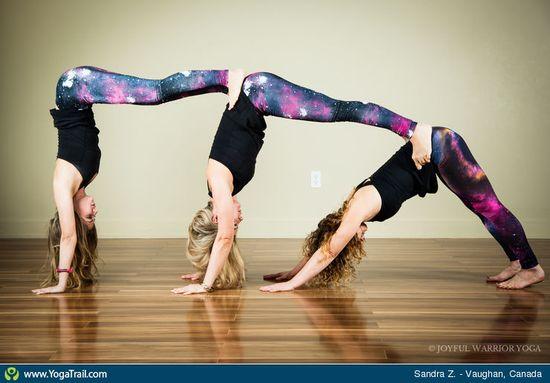
This stacked variation adds balance and coordination to Downward-Facing Dog. One partner establishes a strong Downward Dog while the second partner approaches from behind and places their feet carefully on the lower back or upper thighs only if the supporting partner is comfortable and the arrangement has been taught by a qualified instructor.
A safer progression is to practise two separate Downward Dogs while facing opposite directions, matching the rhythm of the breath. If stacking is attempted, keep the hold brief and prioritise a controlled step-down. Avoid placing weight on the spine, neck, or unsupported lower back.
3. Partner Handstand Preparation
Rather than immediately attempting a fully assisted handstand, begin with one partner in a stable Downward Dog while the other practises a supported kick-up nearby. The assisting partner can help guide the hips or legs without trying to catch uncontrolled momentum.
Both people should be comfortable with the individual version first. Keep the shoulders active, fingers spread, and an exit route clear. This is an advanced balance exercise, not a pose to practise casually without instruction.
4. Twin Chair Pose
Stand back to back with your partner, leaving enough room for both people to place their feet comfortably. Slowly bend the knees and lower into a shared Chair Pose while maintaining gentle contact through the upper backs.
Move at the same pace and stop before either person loses alignment. Keep the knees tracking in the same direction as the toes and distribute weight through the whole foot. This pose can be made more demanding by holding it for several calm breaths, but depth is less important than control.
5. Supported Standing Balance
Face your partner and join one hand or forearm. Each person shifts weight onto one leg while extending the other leg to the side or behind, creating a mirrored balance. The connection should provide light guidance rather than a full pull.
For a greater challenge, gradually extend the free arm or turn the torso. Keep the standing knee soft, focus on a fixed point, and return the lifted foot to the floor before changing sides. This is a useful preparation for more demanding partner balances because both people remain close to the ground.
How to Progress Without Rushing
Practise the individual components first: strong lunges, Chair Pose, Downward Dog, core work, and single-leg balance. Then rehearse each partner’s role separately. The supporting partner needs steady alignment and the flyer needs body awareness; neither role is passive.
Finish every attempt with a deliberate exit and a brief check-in. Ask what felt stable, where pressure appeared, and whether both partners want to repeat the movement. The most successful partner practice is built on consent, patience, and shared control—not on pushing through discomfort.