Practicing yoga with four other people can turn a familiar routine into a shared exercise in communication, balance, and awareness. The goal is not to create the most dramatic shape. It is to move at a pace that allows everyone to feel stable, respected, and included.
The following five-person yoga poses are designed around cooperation rather than strength or acrobatics. Use them with friends, family, or colleagues, and adapt each pose to the group’s experience and comfort level.
Before You Begin
- Choose a clear, level surface with enough room for everyone to move.
- Warm up with easy stretches, shoulder rolls, gentle squats, and several slow breaths.
- Agree on simple communication cues such as “pause,” “release,” and “more space.”
- Never force a stretch, pull on another person, or use someone’s body as a step, seat, or support for lifting.
- Keep the poses grounded. If anyone feels pain, dizziness, or instability, come out of the pose immediately.
1. Five-Point Star
Stand in a circle, facing inward, with enough space to extend your arms. Each person reaches one arm toward the center and the other arm outward, creating a five-point pattern. You can also extend one leg slightly to the side if everyone feels steady.
How to practice
- Stand with feet comfortably apart and soften your knees.
- Extend your arms at shoulder height without locking the elbows.
- Look toward the center of the circle and take three to five slow breaths.
- Lower the arms together and pause before repeating in the opposite direction.
This is a simple way to establish group rhythm without touching or bearing weight.
2. Supported Group Tree
Form a circle and stand close enough to lightly hold hands or touch fingertips with the people beside you. Shift your weight onto one leg and place the other foot on the ankle or lower calf. Avoid pressing the foot into the knee joint.
Use the circle only for gentle balance support; do not lean heavily on your neighbors. Hold for three to five breaths, then change sides. For a more accessible version, keep the toes of the lifted foot on the floor while opening the knee slightly.
3. Seated Circle Twist
Sit in a circle with legs crossed or extended in a comfortable position. Place one hand behind you and the opposite hand on your knee. Everyone twists gently toward the same direction, keeping the spine long.
After several breaths, return to the center and repeat on the other side. The group can use a steady count to move together, but no one should push or pull another person deeper into the twist. This pose encourages calm, coordinated breathing and works well as a transition into relaxation.
4. Five-Person Breathing Circle
Kneel or sit comfortably in a circle. Place one hand on your own abdomen and, if everyone agrees, lightly place the other hand near the center of the circle without touching anyone else.
Choose one person to guide the pace. Inhale together for a comfortable count, pause briefly if natural, and exhale slowly. Continue for five to ten breaths. This is less physically demanding than a balancing pose and gives the group a chance to settle before or after movement.
5. Standing Counterbalance Circle
Stand in a circle and hold hands or interlace only the fingertips. Step back slowly until each person can feel a small amount of shared tension through the arms. Keep the feet grounded and the torso upright rather than leaning far away from the center.
Hold the position for a few breaths, then bend the knees slightly and return to standing together. The aim is to notice how small adjustments affect the entire circle. Use a very light grip, and release immediately if anyone feels pulled or unstable.
Make the Practice Work for Everyone
- Choose a coordinator: One person can call out transitions while the others focus on alignment and breathing.
- Adjust for mobility: Seated versions can replace standing poses, and participants may use a wall or chair for balance.
- Change roles regularly: Let different people lead the breath count or demonstrate the next movement.
- Keep communication direct: Ask before making physical contact and check that everyone is comfortable.
- End quietly: Finish with a few relaxed breaths or a short seated meditation rather than rushing away from the practice.
A Safer Approach to Group Yoga
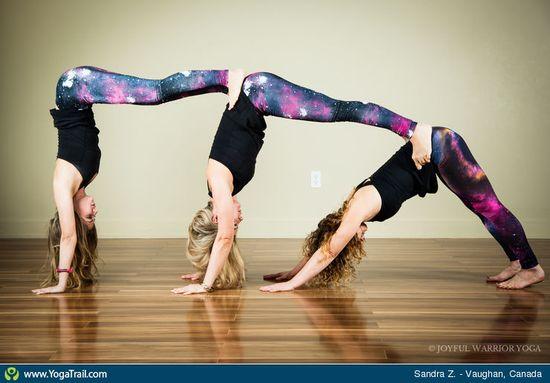
Five-person yoga is most enjoyable when cooperation matters more than performance. Avoid human towers, stacked sitting poses, and other arrangements that require people to climb, lift, or place body weight on one another. Those activities can create unnecessary fall and joint-injury risks, especially when participants have different levels of experience.
With grounded poses, clear communication, and room for individual modifications, a group session can build connection while remaining approachable. The shared rhythm of breathing and moving together is more important than making a complicated shape.