Two-person yoga turns an individual practice into a shared activity built around communication, balance, and mutual support. You do not need to be equally flexible or experienced to enjoy it. The best partner poses are approached slowly, with both people able to adjust the shape or stop whenever something feels uncomfortable.
Before you begin
Choose a clear, stable surface with enough room for both people to move safely. A yoga mat for each person can help with comfort and grip. Wear clothing that allows free movement, and keep blocks, folded blankets, or straps nearby if you need extra support.
- Agree on clear signals: Decide how you will say “stop,” “less pressure,” or “come out” before starting.
- Warm up first: Spend a few minutes with easy movements such as shoulder rolls, gentle twists, cat-cow, and slow squats.
- Communicate throughout: Do not assume your partner knows how much pressure or assistance you want.
- Move gradually: Enter and leave every pose slowly, especially when one person is supporting the other.
- Respect limitations: Avoid forcing a stretch, locking joints, or placing weight on the neck, spine, or unsupported knees.
Anyone with an injury, significant pain, balance concerns, or a condition affected by exercise should seek appropriate professional guidance before trying partner poses. These movements are not a substitute for medical care.
Accessible two-person yoga poses
1. Seated partner twist
This gentle pose encourages upright posture and coordinated breathing without requiring either person to lift or support the other.
- Sit back-to-back with your legs crossed or extended comfortably.
- Take a few breaths and notice the support of your partner’s back.
- On an exhale, both partners slowly twist to the right, placing one hand on the opposite knee and the other hand near the floor or on the thigh.
- Keep the movement comfortable rather than trying to deepen the twist by pulling on each other.
- Return to center, then repeat on the other side.
2. Partner tree pose
Practicing balance together can make standing poses feel more approachable. Use a wall nearby if either person feels unsteady.
- Stand facing each other and hold one or both hands lightly.
- Shift weight onto one foot.
- Place the sole of the other foot against the inner calf or thigh, never directly on the knee. If needed, keep the toes on the floor as a kickstand.
- Find a steady point to look at and take several calm breaths.
- Lower the foot with control and switch sides.
3. Seated partner forward fold
This version offers a hamstring stretch while allowing both people to control their own range of motion.
- Sit facing each other with the soles of your feet touching and knees slightly bent.
- Hold hands or forearms gently, keeping the shoulders relaxed.
- One partner slowly leans back while the other folds forward only as far as comfortable.
- Keep the spine long and avoid pulling your partner toward you.
- Return upright, then change roles.
4. Partner boat pose
Partner boat pose challenges the core and requires steady communication. It is fine to keep the knees bent or the toes lightly touching the floor.
- Sit facing each other with knees bent and feet on the floor.
- Hold hands or wrists without gripping tightly.
- Lean back slightly while keeping the chest open.
- Lift one foot at a time and bring the soles of your feet together, or keep both feet down for an easier variation.
- Hold for a few breaths, then lower your feet together.
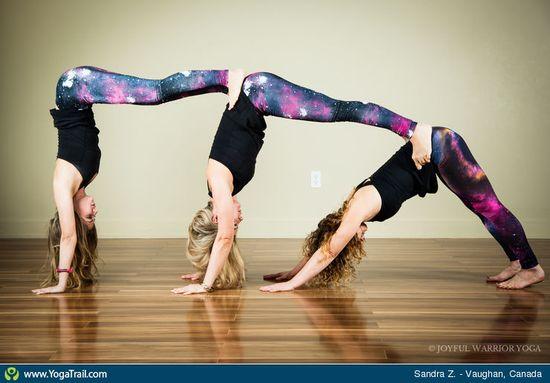
5. Double downward-facing dog
This is a more demanding variation and should be attempted only when both partners can perform downward-facing dog comfortably and have good body awareness. Do not place weight on a partner who is unable to support it.
- One partner begins in downward-facing dog with hands shoulder-width apart and feet grounded.
- The second partner stays behind the first and establishes their own stable downward dog, leaving enough space between the bodies.
- Keep the arrangement non-contact at first. Focus on matching the rhythm of your breathing and maintaining a long, comfortable spine.
- If you choose to add contact, do so only with a qualified instructor’s guidance and a clear exit plan.
How to make the practice work
Begin with poses in which both people remain close to the floor, then progress to standing balance work if you feel stable. Alternate who leads, take breaks between poses, and treat coordination as part of the practice rather than a test. A successful session is not measured by how deeply you stretch or how long you hold a pose; it is measured by whether both partners feel supported and in control.
Closing the session
Finish with a simple seated breathing exercise or a comfortable rest. Take a moment to notice how communication, timing, and shared support affected the practice. With patience and a safety-first approach, two-person yoga can be a playful way to move, build trust, and spend focused time together.