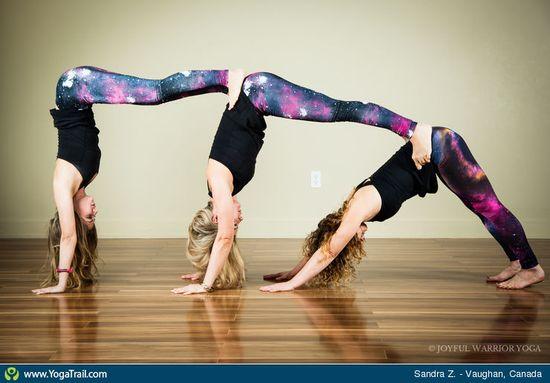
Yoga does not have to be a solo practice. Working with two other people can turn a familiar stretch into a cooperative exercise in balance, communication, and concentration. The best three-person yoga poses are not necessarily the most acrobatic ones. Simple shapes performed with steady breathing and clear communication can be just as rewarding.
Use the ideas below with friends, family members, or classmates. Choose movements that match everyone’s experience level, and treat balance as a shared exploration rather than a performance.
Before You Begin
Three-person poses involve more moving bodies and less personal space than an individual practice, so preparation matters. Practice on a level, non-slip surface with enough room for everyone to extend their arms and legs. A yoga mat for each person can help define personal space, but make sure the mats do not slide apart.
- Warm up with easy shoulder rolls, standing side bends, gentle squats, and wrist and ankle movements.
- Agree on a clear signal such as “stop” or “down” before starting any pose.
- Move into and out of each position slowly rather than pulling or relying on sudden shifts of weight.
- Keep hands on comfortable, stable areas such as forearms or hands. Do not press on another person’s neck, spine, or joints.
- Skip any pose that causes pain, dizziness, fear, or excessive strain.
Accessible 3-Person Yoga Poses
1. Seated Circle Twist
This gentle pose is a good way to begin because everyone remains close to the floor. Sit in a circle with crossed legs or with the legs extended in a comfortable position. Sit tall, relax the shoulders, and take several slow breaths together.
On an inhale, lengthen through the crown of the head. On an exhale, turn toward the person on your right. You can place one hand on your own thigh and the other hand lightly on the floor behind you. Return to center, then repeat on the other side. Keep the twist mild and let each person move at their own range.
2. Three-Person Tree Pose
Stand in a small triangle, leaving enough space between bodies to move safely. Hold hands or lightly connect forearms. Each person shifts weight onto one leg and places the sole of the other foot against the inner calf or thigh—never directly against the knee joint.
Once everyone feels stable, bring the free hand toward the heart or raise it overhead. Keep your gaze on a steady point instead of looking around at the group. Hold for a few breaths, lower the lifted foot with control, and repeat on the opposite side. If balance is difficult, keep the toes of the lifted foot on the floor with the heel resting near the ankle.
3. Supported Group Squat
Form a circle and hold hands or forearms. Walk the feet slightly wider than hip distance, keeping the toes comfortable and the knees tracking in the same direction as the toes. Together, bend the knees and lower only as far as everyone can maintain control.
Pause for two or three breaths, then press through the feet to stand. The support comes from light connection and shared timing—not from pulling one another down or using another person’s arms to lift yourself. Repeat slowly several times, stopping if anyone feels knee or back discomfort.
4. Standing Side Stretch in a Triangle
Stand in a triangle with each person facing the center. Step the feet comfortably apart and extend the arms out to the sides. Each person leans gently toward their own left while keeping both feet grounded and the chest open. Return to upright, then repeat toward the right.
For a more connected version, lightly touch the nearest hands at the center of the triangle without forcing the reach. Keep the movement small enough that everyone can breathe easily. This variation encourages the group to move at one pace while still allowing individual differences in flexibility.
5. Partner-Free Balance Circle
Stand in a circle without holding hands. Shift weight onto one foot and extend the other foot slightly forward, sideways, or behind you. The other two participants balance at the same time. After several breaths, lower the foot and change sides.
Because no one is physically supporting anyone else, this is a useful option for beginners or for groups with different heights and experience levels. The challenge is to stay aware of the group while maintaining your own alignment.
How to Make the Practice Work
Choose one grounding pose, one balance pose, and one gentle stretch rather than trying to complete many difficult shapes. Designate one person to give simple cues such as “inhale,” “lower,” or “release,” then rotate that role so everyone participates in leading.
Most importantly, do not rush into poses that involve lifting, stacking, or placing one person’s full weight on another. Those skills require specialized instruction, careful spotting, and appropriate equipment. For a casual group session, grounded poses provide plenty of opportunity to develop trust and coordination safely.
Finish With a Shared Reset
End by sitting or standing quietly in a circle. Take three slow breaths together, noticing how the group’s pace becomes more coordinated. A successful three-person yoga practice is not measured by how advanced the pose looks; it is measured by whether everyone felt respected, supported, and able to participate.