The position of your body can affect how much stress is placed on your back. Small adjustments to the way you sleep, sit, stand, and move may ease discomfort and make daily activities more manageable. The most helpful position varies from person to person, so use comfort as your guide and avoid any posture or exercise that increases your pain.
Comfortable sleeping positions
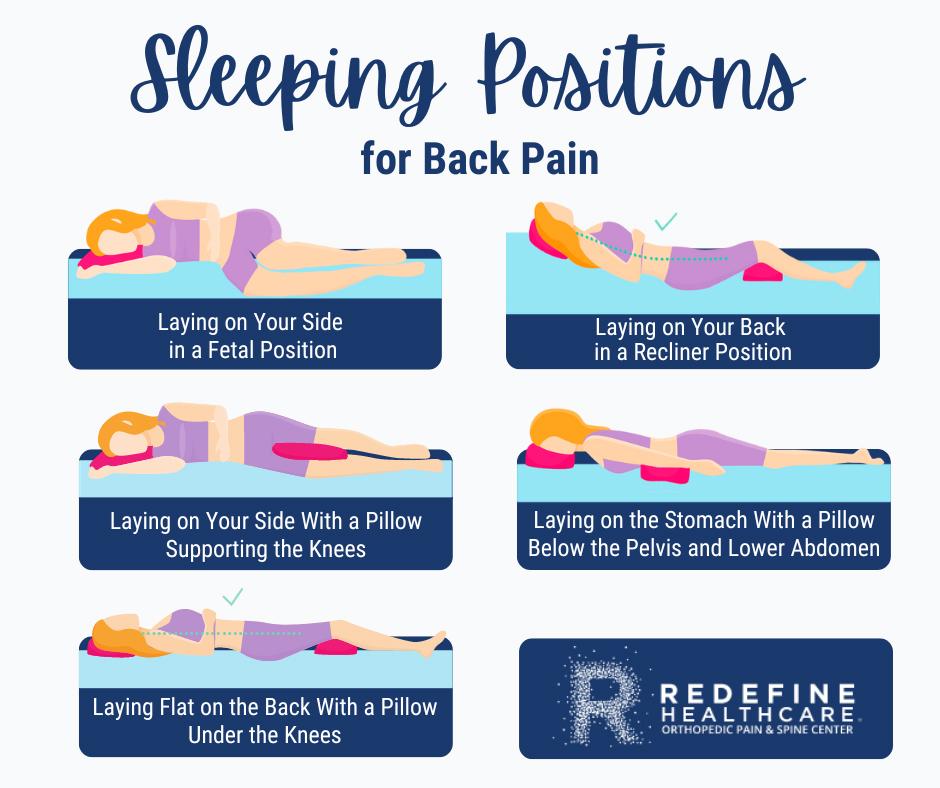
Back pain can make it difficult to find a restful sleeping position. The following options may reduce strain by supporting a more neutral alignment of the spine:
- Side-lying with a pillow between your knees: Keep your knees slightly bent and place a pillow between them. This can help prevent the upper leg from rotating forward and pulling on the lower back.
- Sleeping on your back with support under your knees: A pillow beneath the knees can reduce the amount of arch in the lower back and may feel more comfortable for some people.
- A supported fetal position: Lie on your side and gently draw your knees toward your chest without forcing the movement. This may feel relieving when the back feels stiff.
Choose a pillow that keeps your neck level rather than tilted sharply upward or downward. If a mattress or pillow consistently causes discomfort, changing the amount of support may be worth trying.
Better positions for sitting
Long periods of sitting can aggravate back discomfort, particularly when the pelvis slides forward or the upper body bends toward a screen. Aim for a supported, relaxed position rather than trying to hold yourself rigidly upright.
- Keep both feet supported on the floor or on a footrest.
- Allow your knees to remain roughly level with, or slightly lower than, your hips.
- Use the chair’s backrest or a small lumbar cushion to support the natural curve of the lower back.
- Keep your shoulders relaxed, elbows close to your sides, and wrists in a comfortable neutral position.
- Position your screen so you do not need to bend your head forward for extended periods.
Even a well-adjusted chair cannot replace movement. Change position regularly, stand briefly, or walk for a few minutes instead of remaining seated continuously.
Gentle movements that may relieve stiffness
Slow, comfortable movement can help prevent the back from becoming more rigid. Start with a small range of motion and stop if you feel sharp, worsening, or radiating pain.
Cat-cow movement
Begin on your hands and knees, with your hands beneath your shoulders. Slowly round your back, then gently move in the opposite direction without forcing your lower back to dip. Repeat several times at a steady pace.
Child’s pose
From a hands-and-knees position, move your hips back toward your heels only as far as comfortable. You can widen your knees or place a cushion beneath your hips or chest for support. Come out of the position if it increases symptoms.
Gentle extension
Some people feel comfortable lying on their stomach and propping themselves lightly on their forearms, while others find this position irritating. Try it only if it feels easy and does not increase pain in the back, buttocks, or legs.
How to use these positions during the day
- Use short movement breaks during work, travel, or other activities that require prolonged sitting.
- When standing, distribute your weight evenly rather than leaning on one leg for long periods.
- When lifting, keep the object close to your body and avoid twisting while carrying it.
- Try one change at a time so you can identify which position helps and which one aggravates your symptoms.
- Keep activity gentle but regular when movement is tolerable; prolonged bed rest may increase stiffness for some people.
When to seek medical advice
Back pain has many possible causes, and positioning alone may not resolve it. Arrange an assessment if pain is severe, keeps returning, lasts longer than expected, or interferes with sleep or ordinary activities. Seek urgent medical care for back pain accompanied by new weakness, significant numbness, loss of bladder or bowel control, numbness around the groin, fever, or pain following a serious injury.
The goal is not to maintain one perfect posture all day. A supported position that feels comfortable, combined with regular gentle movement and sensible breaks, is often a more practical approach to managing everyday back discomfort.